
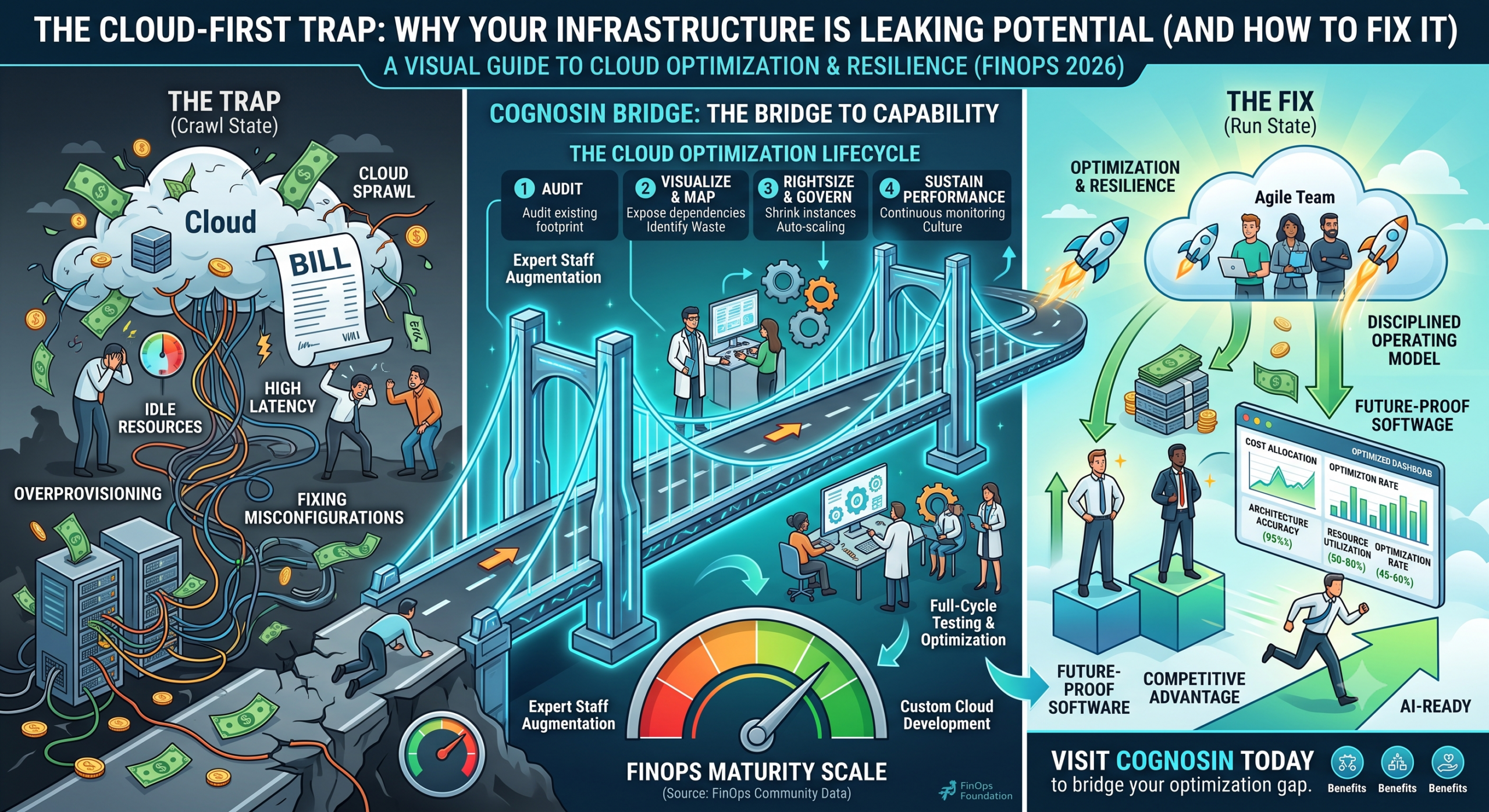
Imagine this: You’ve just greenlit a massive migration to the cloud optimization strategy.
The team is buzzing, the servers are provisioned, and you’re ready to scale your application globally.
Three months later, reality hits hard. Your monthly cloud bill is ballooning out of control. Latency is creeping into the user experience, and your “agile” engineering team is spending more time fixing deployment misconfigurations than shipping actual features.
You aren’t alone. In 2026, the tech industry is aggressively shifting from treating the cloud as merely a destination to treating it as a highly disciplined operating model. The gold rush of simply “lifting and shifting” legacy software without a plan is officially over.
To survive and scale efficiently, you must implement a rigorous cloud optimization strategy.
Table of Contents
-
The Silent Killer: Complexity vs. Capability
-
Where Your Budget is Actually Going
-
Visualizing the Impact: Cloud Inefficiency Metrics
-
7 Steps to a Bulletproof Cloud Optimization Strategy
-
Bridging the Gap with Cognosin
The Silent Killer: Complexity vs. Capability
As organizations rush to build AI-ready infrastructure, they face a quiet margin-killer: Cloud Sprawl.
Cloud sprawl is the uncontrolled growth of cloud instances, services, and environments without centralized tracking or accountability.
When leadership treats cloud spend as a purely variable expense rather than a core design discipline, the bottom line inevitably suffers. A proactive cloud optimization strategy shifts this paradigm, turning your infrastructure from a financial black hole into a competitive advantage.
Where Your Budget is Actually Going
Before you can optimize, you need to understand the source of the leak. Here are the three main culprits draining your cloud budget:
-
Idle Resources: Ghost instances, unattached storage volumes, and forgotten staging environments left running 24/7.
-
Overprovisioning: Paying for massive, enterprise-grade compute instances “just in case,” when much smaller ones would handle the load perfectly.
-
Data Egress & Storage: Unoptimized data movement across regions that triggers heavy transfer fees and introduces performance-killing latency.
Visualizing the Impact: Cloud Inefficiency Metrics
Most organizations operate with a “black box” view of their cloud. Without clear visualization of your architecture, you simply cannot optimize what you cannot see.
Implementing a robust cloud optimization strategy requires tracking specific FinOps KPIs. Below is a breakdown of organizational maturity metrics (the Crawl vs. Run stages) mapped directly from the FinOps Foundation framework:
| Metric | Typical “Crawl” State | Ideal “Run” State |
|---|---|---|
| Cost Allocation Coverage (Tracking every dollar) | 70–85% | 95%+ |
| Architecture Accuracy (Real vs. documented setup) | 70–80% | 90%+ |
| Resource Utilization (Active compute load) | Less than 30% (Wasteful) | 60–80% (Optimized) |
| Optimization Rate (How fast waste is cleared) | 10–20% | 45–60% |
The Performance Gap
-
The Low End: When CPU and memory utilization sit consistently below 30%, you aren’t being “safe”—you are leaking capital.
-
The High End: Conversely, when utilization spikes above 80% without automated scaling triggers, you risk severe performance degradation, application crashes, and lost revenue.
7 Steps to a Bulletproof Cloud Optimization Strategy
To break out of the initial “crawl” state, your engineering team needs a repeatable lifecycle to spot waste and lock in continuous savings. Here is a proven, 7-step cloud optimization strategy you can deploy today:
1. Conduct a Comprehensive Audit Assess your existing cloud footprint across all providers (AWS, Azure, GCP). Tag all active resources and pull real-time billing data to understand baseline costs.
2. Visualize and Identify Waste Deploy visualization tools to expose hidden dependencies. Locate idle resources, unattached IP addresses, and orphaned snapshots. Map out exactly where the budget is leaking.
3. Rightsize Your Instances Shrink overprovisioned instances based on historical CPU and memory utilization data. Match your instance families to the specific workload requirements.
4. Automate Scaling Triggers Implement robust auto-scaling groups. Ensure your architecture spins up resources during peak traffic and automatically spins them down during off-hours.
5. Leverage Commitment Discounts Once your baseline compute is stabilized and rightsized, purchase Reserved Instances (RIs) or Savings Plans to secure massive discounts on predictable workloads.
6. Shift Left on QA and Testing Integrate continuous automated testing early in your deployment pipeline. Catching performance bottlenecks before they hit production prevents expensive post-deployment fixes.
7. Build a Sustainable FinOps Culture Establish continuous monitoring and financial accountability among developers. A successful cloud optimization strategy relies on cross-functional collaboration between engineering, finance, and leadership.
Watch this brief video overview on establishing a FinOps culture:
Title: Introduction to Cloud FinOps – Cloud Financial Management Basics Explained URL:http://www.youtube.com/watch?v=OJzFhWdT-fo
Bridging the Gap with Cognosin
Building a modern cloud environment is only half the battle. Maintaining it with the right engineering talent and rigorous quality standards is what actually wins the war.
If your internal team is struggling to keep pace with the demands of scaling, or if you need help executing a comprehensive cloud optimization strategy, Cognosin provides the specialized bridge you need:
-
Expert Staff Augmentation: We connect you with top-tier CloudOps and QA engineers who seamlessly integrate into your workflow to handle complex migrations and day-to-day management.
-
Full-Cycle Testing & Optimization: Don’t let a deployment bug derail your growth. We perform rigorous performance, stress, and security testing to ensure your cloud solutions are reliable, bug-free, and blazing fast.
-
Custom Cloud Development: Whether you’re building an AI-ready application from scratch or overhauling a legacy architecture, we leverage modern cloud-native practices to deliver scalable, future-proof software.
Don’t let technical debt hold back your growth. Your cloud strategy should be a sharp competitive advantage, not a financial burden.
Ready to optimize your cloud journey, eliminate waste, and scale intelligently? Visit Cognosin today and let our experts transform your infrastructure.
